Layering
How to layer necklaces without tangling them
The two-inch rule, which chain goes on top, and three stacks you can build without a single knot.
Published September 15, 2026 · 5 minute read
- Keep two inches between chains
- Decide which chain goes where
- Mix chain types so the layers stay distinct
- Three stacks to start with
- Put them on in order and keep them apart
- Stacking bracelets
Keep two inches between chains
Most tangled stacks are not a clasp problem or a chain problem. They are a length problem. Two chains less than about two inches apart rest on the same curve of your neck, and every time you turn your head they roll over each other until they twist into one.
Two inches is enough for each chain to settle on its own line. You can see the rule in our three-chain stacks: the satellite chain is 15 inches, the wave chain 17, and the paperclip or box chain 19. Nothing about those numbers is decorative. They are the gaps that keep a stack apart through a day at a desk.
If you are combining necklaces you already own, lay them out on a table in order of length before you put anything on. Any pair closer than two inches is where the knot will start. Move one clasp along its extender, or swap one necklace for a longer one, and the problem usually goes before it begins.
Your build plays a part too. On a longer neck, chains fall further apart than the labels suggest, and on a shorter neck they crowd. Check the finished stack in a mirror, then look down at your phone for a moment and see whether the chains touch.

Yoosteel Thin box chain stack
Layered necklace set, 3 pieces · from $14.99

Decide which chain goes where
A stack reads best from top to bottom, fine to bold. Put the most delicate chain highest, near the base of the neck, where a heavy chain would feel tight. Let a chain with more texture sit lower. The weight helps it hang straight, and the difference in thickness makes the layers easy to tell apart.
Choose one piece to be the point of the stack, usually a pendant, and give it the middle or the lowest chain. Two pendants at once compete, and on a busy day one of them ends up flipped behind the other.
Think of three chains as three jobs. The top chain frames the neckline. The middle one carries the detail, a letter, a pearl or a small stone. The bottom chain finishes the stack and can be the plainest of the three.
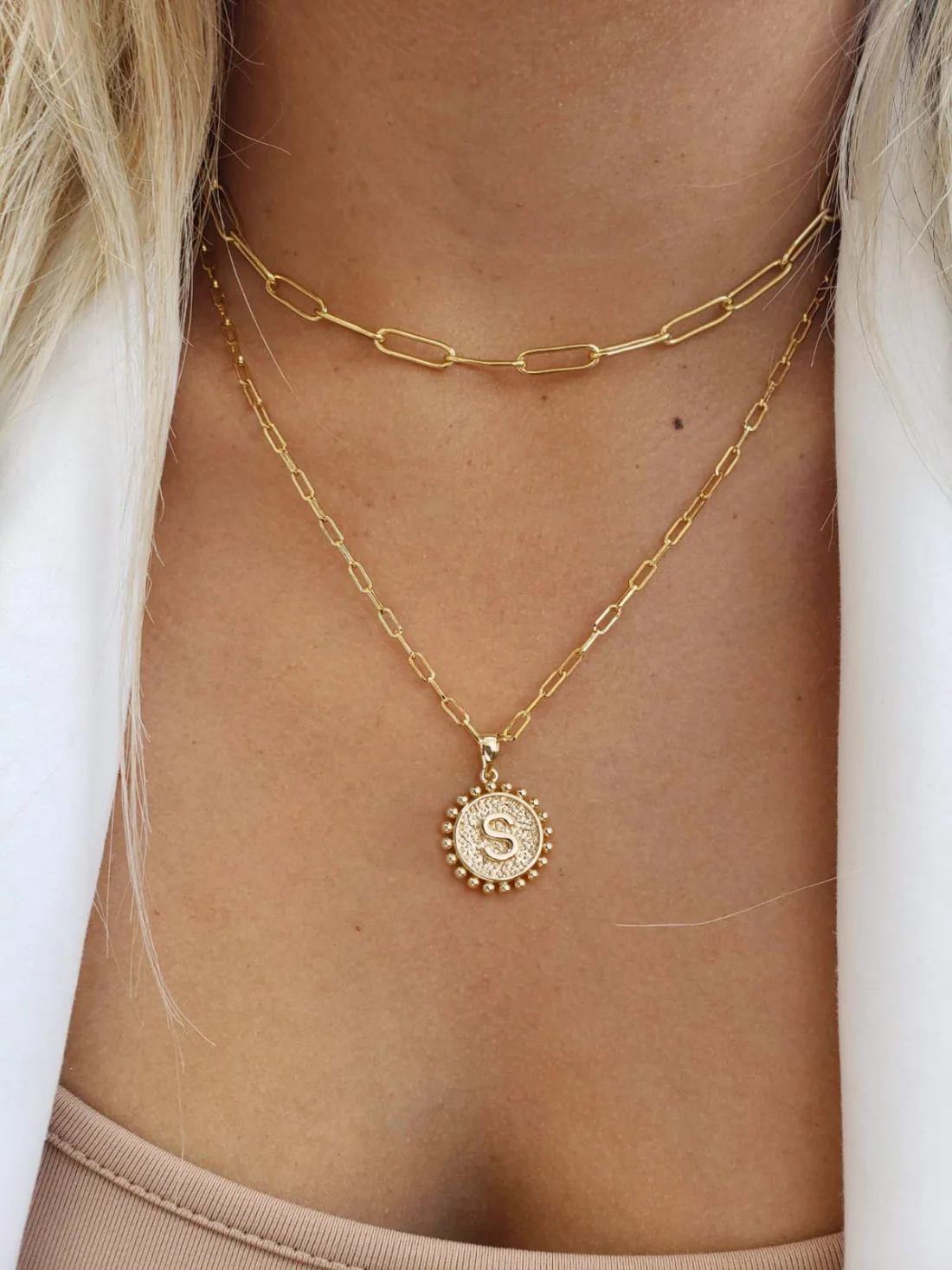
Our bead choker initial is a small example of the same idea: a 14-inch chain of tiny beads above a 16-inch chain with the letter, so the letter is the only thing that hangs.
Mix chain types so the layers stay distinct
Chains that look alike blur into one line. Chains with different textures stay readable even when they sit close.
Each common chain has its own character. A satellite chain is fine with small beads spaced along it. A wave chain has a flat, rippled link that catches light as you move. Paperclip links are long and open. A box chain is square and smooth, and a bead chain is a row of tiny balls.
A reliable mix is two textures and one plain chain, for example satellite above, paperclip below, and a smooth chain in between. The plain chain gives the eye a rest, and the textured ones mark the layers.
Metal tone is the other choice. One tone throughout gives a quiet stack. Mixing gold and silver works as well, as long as it looks decided: repeat each tone at least twice, or keep the silver to a single, clearly separate piece.
Three stacks to start with
A letter stack. Take the bead choker initial as it comes: a 14-inch bead chain and a 16-inch chain with your letter. The beads sit near the base of the neck and the letter hangs below them. Add a third chain at 18 inches only if it is plain.
A pearl stack. Wear one of our CZ stack wave chokers at 15 inches with a pearl pendant necklace at 16. One inch is closer than the usual rule, and it works because the pearl hangs below its own chain, so the part you see sits well under the choker.
A lariat stack. Our layered lariats already are one: a 15-inch chain above an 18-inch Y-shaped chain, with a 3-inch drop down the center. Wear it with a V neck or an open collar and add nothing else at the neck. The drop does the work that a third chain would.
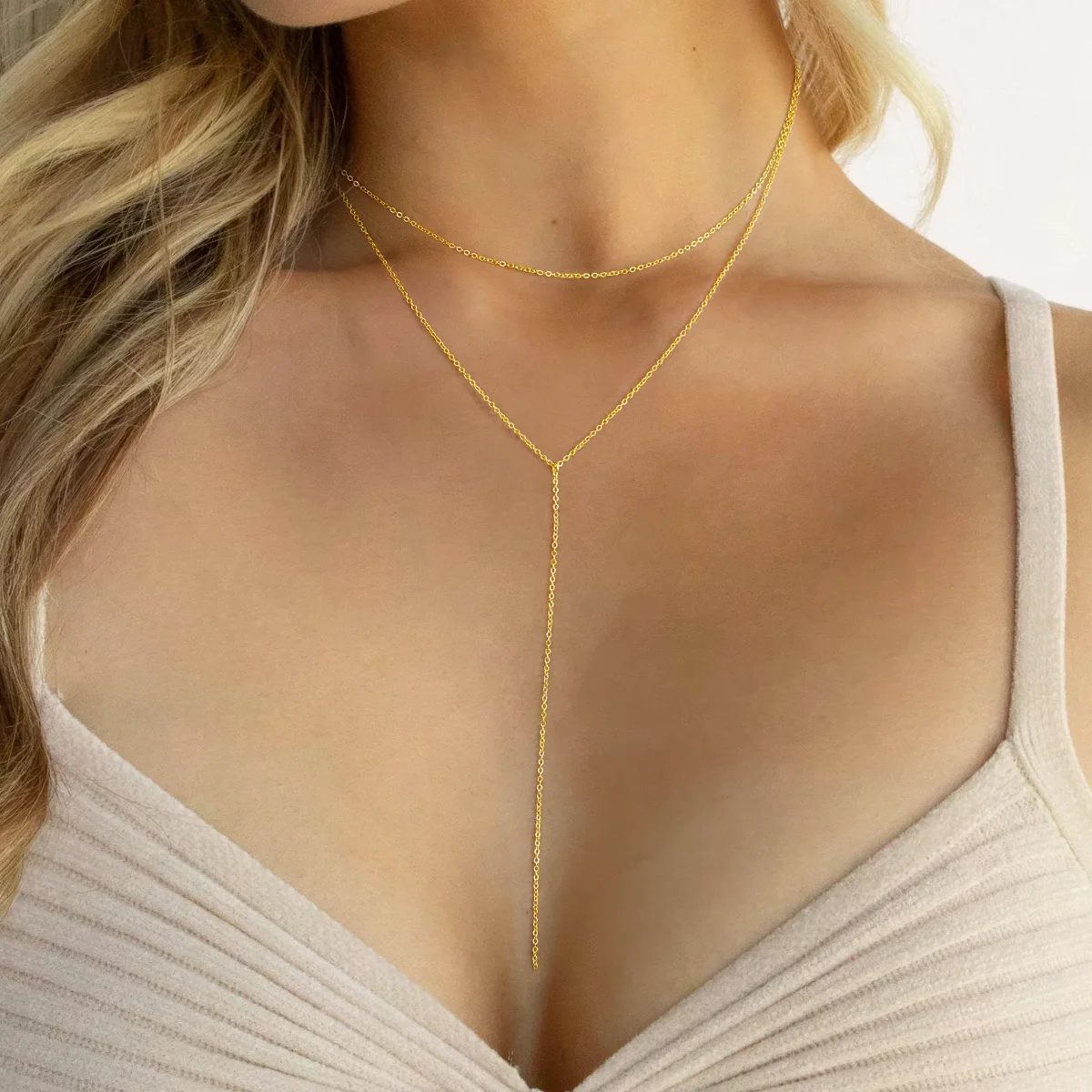
Yoosteel Simple layered lariat necklace
Y-shaped lariat necklace · from $12.99
Put them on in order and keep them apart
Fasten the longest necklace first and the shortest last. Each new chain then goes on above the ones already in place, instead of getting trapped underneath them.
Turn the clasps to the back once everything is on. A clasp that creeps around to the front pulls its chain off center and drags the others with it.
If the chains twist during the day, do not pick at the knot. Lean forward and let the necklaces hang for a moment, then straighten up. Most twists fall out on their own, and the extender lets you add a link of space to the chain that keeps causing trouble.
At night, take them off in the reverse order and store each one on its own, with the clasp closed. A chain stored loose in a dish with two others is a knot waiting for the morning. For travel, thread a fine chain through a drinking straw and close the clasp outside it.
Stacking bracelets
The wrist follows the same logic as the neck: separate textures, one piece that stands out, and a sensible order.
Start with stretch bead bracelets. Our sets come as five or six strands, 7 inches around, with beads from 2 mm to 6 mm, and some mix in pearls up to 10 mm. Graduated sizes already give the stack depth.
Add one bracelet with a different character next to the beads, a CZ tennis bracelet or a hand chain. Our tennis bracelets use 3 mm stones and come in 6.5, 7 and 7.5 inches, and our hand chains run a 6-inch chain with a 2-inch extender to a ring.
Wear the stack on the wrist that does less typing. A wrist that rests on a keyboard all day wears beads and scuffs stones faster. Roll stretch strands over your hand rather than pulling them wide, and take the stack off before washing up.
Our three-chain stacks are built on the Yoosteel approach, with two inches between every chain and a clasp on each.